The first time I taught a Hybrid course (2009) I fell in love with the format. (I'm the kind of person who falls in love with things like formats.) It was an advanced writing course for ESL students, and I took full advantage of blogging. We met once a week for 4 hours on Friday mornings; went over some grammar points, often doing small group activities to reinforce them, did some sharing of our writing, and started discussing our next topic/writing style. Everyone left with a writing project for their blog; I went over these on Wednesdays and made comments and suggestions. They could easily re-publish their posts, and I encouraged the use of visuals to enhance their writings. I watched in fascination as the combination of blog ownership, the ease of corrections and the joy of sharing their writings (we sometimes went "Blog Hopping") empowered them to become much more confident and effective writers. From there I developed a hybrid reading course. That joy I felt with those classes was the main reasons I felt hesitation when I had a chance to shift to a new position related to faculty development.
Little did I realize at that point that my new position would take me even further into the realm of online teaching. I was introduced to the Quality Matters rubric for online teacahing in my first month on the job and - you guessed it! - fell in love with the format. Coming quickly on the heels of my training was a deep need at our institution to develop excellent online teachers. I worked with one of our Deans to put together a month-long online in-service for online teachers that highlighted their best practices. The more I worked with community college teachers the more I felt the need for information on utilizing technology and creating inclusive online and hybrid courses. With the need was so obvious and the teachers so interested in learning, I put together a month-long course for educators called "Technology for Teaching and Learning". It immediately filled up; I just finished the second round. And I find that online teaching can indeed be effective and inspiring as classroom teaching.
Online teaching has a quieter personality from hybrid teaching, but like a lot of people with quiet personalities that take a while to get to know, they end up being your best friend.
With online teaching, you can't see what the student is wearing. But you can see what the student is wondering. The excellent online teacher pays attention to discussions, makers herself available to questions, and sets up a course that is easy to navigate with an atmosphere that welcomes (not threatens) students. There are so many ways to connect with students personally online; you can respond to their needs with explanations, links to websites, and images. I always hated trying to draw things on the whiteboard, and frankly my handwriting is atrocious; my online courses have wonderfully engaging images (I use my camera often) and a great selection of readable fonts.
The more I work with course development the more ways I find to communicate and develop relationships with my students, and for them to learn from each other as well. I am finding that discoveries and sharing from my online courses - which I can revisit whenever I want - reverberate in my mind longer than a ground class.
Teaching online means teaching with the world at your fingertips. This means state-of-the-art possibilities with tools and technology. It literally means the best minds in the world can be part of your class materials. It means your students can study anytime, anywhere, and can ask you any question they want without disrupting class. As I prepare to teach the second iteration of the Canvas course "Hybrid Courses: Best of Both Worlds" - a massive online course about hybrid teaching - I reflect daily on these two teaching formats, comparing them as well as reflecting on and building my own approach and philosophy. The thing I look forward to the most in facilitating the course again is the communication and idea exchange that will go on between the participants, as they learn from and inspire each other. We'll be using a variety of technology I'm incorporating into the course - and developing Hybrid Course Planners along the way. I am also excited because we will have a fantastic guest speaker; Jesse Stommel will join us in a google hangout! I can't wait for this next adventure. (Interested educators from any field are welcome! Enroll here.)
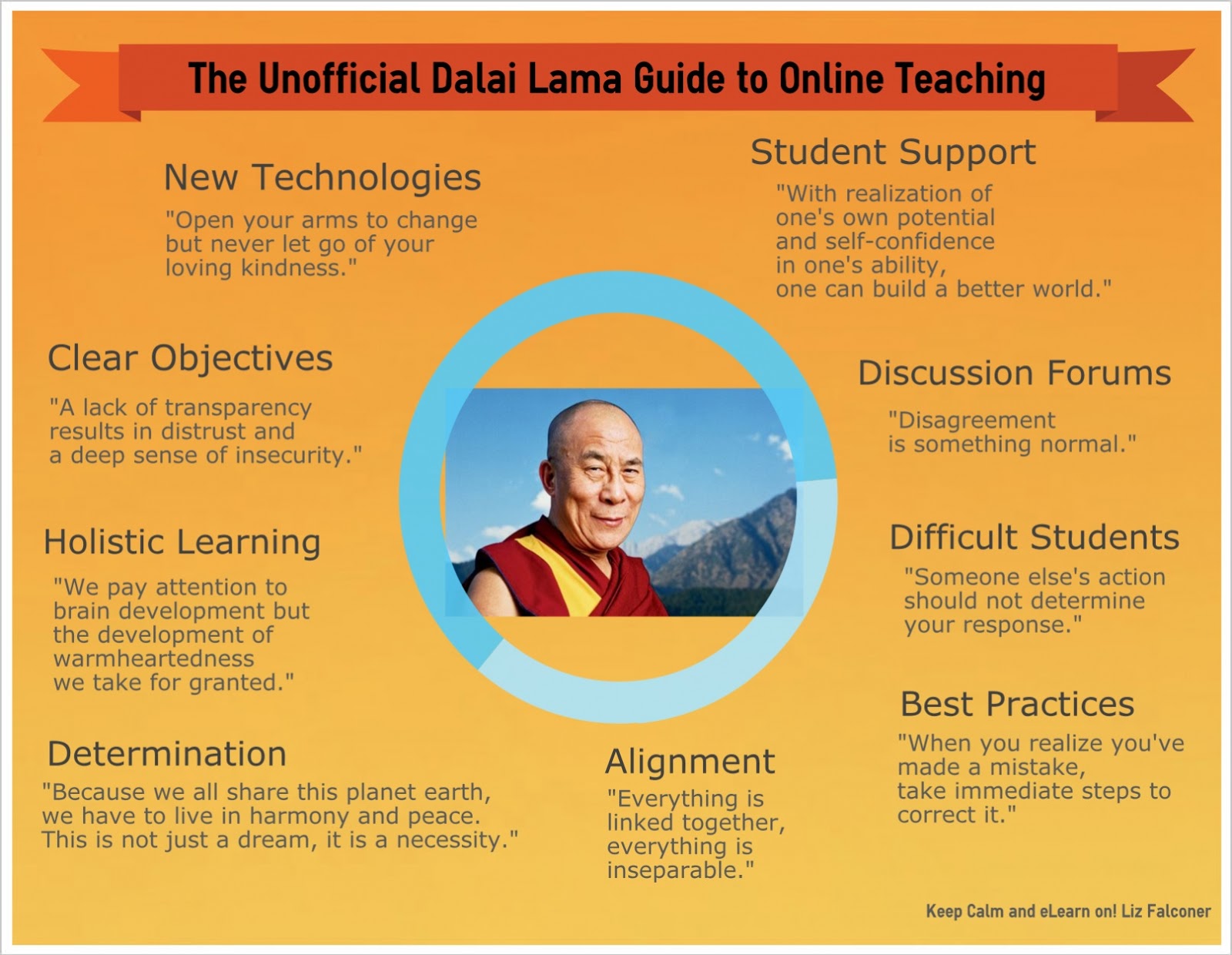
I created this week's infographic, thinking about online teaching:
Showing posts with label online education. Show all posts
Sunday, September 15, 2013
Wednesday, August 28, 2013
Care and Feeding of Online Students
A few weeks ago I attended a conference for Higher Education administrators from Community Colleges with a focus on Big Data. Big Data, we heard, is Huge. Massive. A Big Deal: We can now look at user behavior by counting mouse clicks as people navigate a website, see how many page views and what time of the day a student is doing homework, and break that down even further; maybe we can even start to tell students what time of day they study best, by looking at their results. We can see where online students get stuck, giving educators an idea of how to better explain things. With Big Data, we don't ask questions and look for the answer; the "data-first philosophy" mashes together the information from social networks and everywhere else on the web and we gain insights from what it tells us. And the cost is low; we can experiment often, looking for correlation rather than causation. It has turned analysis on its head, and everyone is bubbling with its potential.
The burning question among educators, as we shift our courses to various new models of blended and online learning, is: How can we make our students (especially those online students) more successful? (In other words, retention, retention, retention.) Obviously the online class has incredible potential; besides the time and money in transportation alone it frees up for the very busy community college student - many of whom are studying in a second language, are single parents and working at least part time - the online environment offers pathways to information and tools that can enhance, supplement and support learning at every level. The answer to that, from what I could gather from the Big Data experts, is to use the now-incredible power of data to analyze performance, use course analytics and hire very specialized experts in Big Data to glean how students are performing and how to make them perform better. (The "low cost" part breaks down a bit here.)
I am happy for Big Data; what a wonderfully useful tool to come out of our computer lives! But the whole time I listened to the presentations (many of which were coming from people involved with companies standing to benefit from Big Data users) I felt a nagging concern.
No one was talking about caring. The way to make any student stay involved is to make a personal connection and recognize that student as an individual. Even in my MOOC, even more than I expected, I was able to connect with my students by being a part of the discussions, responding as much as possible to as many as possible. ( I facilitated it along with doing my regular job, spending an hour in the morning and a few hours in the evenings checking in and answering questions.) I also structured the course so that the students had a chance to learn about themselves and each other as an integral part of the learning experience. We had a Facebook page, used twitter (#CnHyBest) and I made frequent announcements and updates, sometimes incorporating student responses. One of my early tweets was, "This MOOC classroom is so vibrant and international...can feel the energy pulsing from the computer!" Over a third of the active participants completed the final project for a certificate of completion...a very high rate for a MOOC course.
Caring doesn't sound very academic and it certainly isn't as new as Big Data. But I think any course that has a strong element of caring will retain more students than a course with low teacher-student interaction. The key is having an involved teacher who is trained not just in the subject matter but also to listen, watch for falters, be ready to gently cajole, try new things, and convey a sense of enthusiasm. Online teaching allows us so much more than more data; it allows us to have personal conversations with many people, and for them to have conversations with each other. We should be looking at it as a chance to get personally involved with our student success. MOOCs aside, the online teacher can reach each and every student in a way that empowers and motivates them. Each teacher needs to embrace the idea that we can have an effect on student lives beyond the subject matter. This is a skill that needs to be understood and talked about as much as anything else when it comes to student success.
This was on my mind when I saw a quote by the Dalai Lama on a friend's facebook page : "Open your arms to change, but never let go of your loving kindness." I created the infographic below thinking that I want to get more of a conversation going about this aspect of online teaching among educators. For increased student success, the answer is so clear.
(By the way I will be teaching the course again starting Oct. 21st; you can find it at The Canvas Network - Hybrid Courses: Best of Both Worlds.)
The burning question among educators, as we shift our courses to various new models of blended and online learning, is: How can we make our students (especially those online students) more successful? (In other words, retention, retention, retention.) Obviously the online class has incredible potential; besides the time and money in transportation alone it frees up for the very busy community college student - many of whom are studying in a second language, are single parents and working at least part time - the online environment offers pathways to information and tools that can enhance, supplement and support learning at every level. The answer to that, from what I could gather from the Big Data experts, is to use the now-incredible power of data to analyze performance, use course analytics and hire very specialized experts in Big Data to glean how students are performing and how to make them perform better. (The "low cost" part breaks down a bit here.)
I am happy for Big Data; what a wonderfully useful tool to come out of our computer lives! But the whole time I listened to the presentations (many of which were coming from people involved with companies standing to benefit from Big Data users) I felt a nagging concern.
No one was talking about caring. The way to make any student stay involved is to make a personal connection and recognize that student as an individual. Even in my MOOC, even more than I expected, I was able to connect with my students by being a part of the discussions, responding as much as possible to as many as possible. ( I facilitated it along with doing my regular job, spending an hour in the morning and a few hours in the evenings checking in and answering questions.) I also structured the course so that the students had a chance to learn about themselves and each other as an integral part of the learning experience. We had a Facebook page, used twitter (#CnHyBest) and I made frequent announcements and updates, sometimes incorporating student responses. One of my early tweets was, "This MOOC classroom is so vibrant and international...can feel the energy pulsing from the computer!" Over a third of the active participants completed the final project for a certificate of completion...a very high rate for a MOOC course.
Caring doesn't sound very academic and it certainly isn't as new as Big Data. But I think any course that has a strong element of caring will retain more students than a course with low teacher-student interaction. The key is having an involved teacher who is trained not just in the subject matter but also to listen, watch for falters, be ready to gently cajole, try new things, and convey a sense of enthusiasm. Online teaching allows us so much more than more data; it allows us to have personal conversations with many people, and for them to have conversations with each other. We should be looking at it as a chance to get personally involved with our student success. MOOCs aside, the online teacher can reach each and every student in a way that empowers and motivates them. Each teacher needs to embrace the idea that we can have an effect on student lives beyond the subject matter. This is a skill that needs to be understood and talked about as much as anything else when it comes to student success.
This was on my mind when I saw a quote by the Dalai Lama on a friend's facebook page : "Open your arms to change, but never let go of your loving kindness." I created the infographic below thinking that I want to get more of a conversation going about this aspect of online teaching among educators. For increased student success, the answer is so clear.
(By the way I will be teaching the course again starting Oct. 21st; you can find it at The Canvas Network - Hybrid Courses: Best of Both Worlds.)
Sunday, March 24, 2013
Online Ed: 3 Ways to Save Time
There is a landslide of press on online teaching and learning....Who would have thought things could change so completely and dramatically? What. A. Revolution.
As an online teacher and learner, I have found that there is only one way to succeed: Stop doing everything else. I mean, Everything. You can no longer go to the store, do the dishes, feed the cat, pet the dog, or vacuum. You are now riveted to your computer, about to finish, almost ready to be done, just one more post to write, one more website to browse, and oh! a tweet just for me! How delicious.
Surely your husband/wife/partner/kids will undertand that just as sooooon as you finish this, you will be with them. Just a few minutes more....
Somehow others seem to be able to combine extremely in-depth online teaching and learning with real life (or IRL, they call it) but I have not quite figured out how. In the meantime, What to do? Here are some time-saving hints I have come up with:
1. Eat off of paper plates. I mean, look at how much you are saving the environment by going paperless! It is only fair that you are allowed a little paper in return, right? And think of the time it will save you in washing dishes (and putting them away, if you even even wasted time with that.) Think of the water bills you are saving on.
2. Stop looking in the mirror. Really it is too depressing, when you see what you now look like. Just keep using the same avitar or that one photo of that one time you looked great, and get on with it. In the online world, it really doesn't matter. It just takes time away from your online presence, and as a teacher or student, that presence is the core of your identity.
3. Start seeing the beauty of letting a sunny day go by without going outside. In the evenings, don't even wonder if there is a moon or not; enjoy that computer glow on your determined face and watch your keyboard light up as day turns to night. Fresh air is overrated - once you have let the first day go by, the rest are easier. Stay focused, and keep typing. Don't let the world distract you! If you never, ever look up when someone tries to have a conversation with you, they will eventually give up and leave you alone.
Surely this will get better soon, and I can somehow regain what used to be my life. I understand Shirkey's concept of "It's not information overload, it's filter failure"....and as soon as I figure out how to get a filter on my filters, winnow down the sites, tweets, blogs, videos, discussions and chats, I'll join you at the poolside.
But first, I really want to explore this online education stuff, and the rest can just wait.
As an online teacher and learner, I have found that there is only one way to succeed: Stop doing everything else. I mean, Everything. You can no longer go to the store, do the dishes, feed the cat, pet the dog, or vacuum. You are now riveted to your computer, about to finish, almost ready to be done, just one more post to write, one more website to browse, and oh! a tweet just for me! How delicious.
Surely your husband/wife/partner/kids will undertand that just as sooooon as you finish this, you will be with them. Just a few minutes more....
Somehow others seem to be able to combine extremely in-depth online teaching and learning with real life (or IRL, they call it) but I have not quite figured out how. In the meantime, What to do? Here are some time-saving hints I have come up with:
1. Eat off of paper plates. I mean, look at how much you are saving the environment by going paperless! It is only fair that you are allowed a little paper in return, right? And think of the time it will save you in washing dishes (and putting them away, if you even even wasted time with that.) Think of the water bills you are saving on.
2. Stop looking in the mirror. Really it is too depressing, when you see what you now look like. Just keep using the same avitar or that one photo of that one time you looked great, and get on with it. In the online world, it really doesn't matter. It just takes time away from your online presence, and as a teacher or student, that presence is the core of your identity.
3. Start seeing the beauty of letting a sunny day go by without going outside. In the evenings, don't even wonder if there is a moon or not; enjoy that computer glow on your determined face and watch your keyboard light up as day turns to night. Fresh air is overrated - once you have let the first day go by, the rest are easier. Stay focused, and keep typing. Don't let the world distract you! If you never, ever look up when someone tries to have a conversation with you, they will eventually give up and leave you alone.
Surely this will get better soon, and I can somehow regain what used to be my life. I understand Shirkey's concept of "It's not information overload, it's filter failure"....and as soon as I figure out how to get a filter on my filters, winnow down the sites, tweets, blogs, videos, discussions and chats, I'll join you at the poolside.
But first, I really want to explore this online education stuff, and the rest can just wait.
Thursday, February 28, 2013
Customized Education
I am massively MOOCing. In a Canvas Network MOOC on Social Media and actually learning how to make sense of my twitter account which has been largely dormant. Learning: Social Media =#SoMe ...oh me, so me, this is incredible. Now I see....LINKS to great writing and COMMENTS and INSIGHTS. OH!!!!!! Starting to get it.
Maria Anderson from Canvas is teaching the MOOC....the person who tweeted her dissertation one hour at a time. So I decided to tweet the book I'm reading for the class one chapter at a time: Inevitable Mass Customized Learning, by Charles Schwahn and Beatric McGarvey. So readable, so right.
Customize our education: I'll have mine grande, double shot, peppermint mocha. What? Of COURSE I want whip!!
WAKE UP, EDUCATORS and ADMINISTRATORS! THE REVOLUTION IS HERE NOW...but I don't see much progress towards even recognizing it at the small technical college where I work, which is struggling with enrollment. CUSTOMIZED LEARNING is where it's at!
The reality of how we should be changing versus how we are not changing has gotten my brain thinking in ALL CAPS.
Maria Anderson from Canvas is teaching the MOOC....the person who tweeted her dissertation one hour at a time. So I decided to tweet the book I'm reading for the class one chapter at a time: Inevitable Mass Customized Learning, by Charles Schwahn and Beatric McGarvey. So readable, so right.
Customize our education: I'll have mine grande, double shot, peppermint mocha. What? Of COURSE I want whip!!
WAKE UP, EDUCATORS and ADMINISTRATORS! THE REVOLUTION IS HERE NOW...but I don't see much progress towards even recognizing it at the small technical college where I work, which is struggling with enrollment. CUSTOMIZED LEARNING is where it's at!
The reality of how we should be changing versus how we are not changing has gotten my brain thinking in ALL CAPS.
Labels:
mooc,
online education,
social media,
teaching and learning
Friday, February 15, 2013
The 3-day rule
My husband and I studied Japanese together and then lived in Japan for 12 years studying Japanese music and language (and of course teaching.) While we were there, we had what we called the "Three-day rule." That was, whenever we learned a new, useful word or pharse, within three days, we would suddenly hear someone using it.
What was amazing about this was that of course people had been using those phrases all along, but since they weren't in our active vocabulary, we weren't hearing them. As second-language learners, we clung to what we could recognize, took in body language and context, to glean much of our information. And then suddenly, HEY!! Everyone has been saying this phase to me that I just couldn't hear because there was no context. After I had learned the phrase, I was able to scaffold it into my active listening ears and mind.
We are both optimists, and didn't let the fact that the endless learning of new phrases was, well...endless. As soon as one three-day rule phrase popped up, we'd learn another one, again and again. We persevered with our learning, enjoying the process. When you take on something as big as a language and culture, the journey never ends.
Recently I've revised that three-day rule to apply to the language and culture of the internet. During winter break I went to my neighbors' annual New Year's party and she told me she was taking a Coursera course in contemporary poetry. She's a nurse. "What's that?" I asked, and she explained what a MOOC was. When I got back to my work computer, I signed up for a Coursea course (I was in the one that crashed) and also suddenly noticed the email titles with MOOC in them. I know they were there before. I just had no context for them.
The same has been true for OER (such an incredible concept that many teachers are just getting a grasp of), and the many offerings of Google. (Have you tried a hangout? Amazing.) The challenge is to stay on top, keeping my ears and eyes open for the most useful, developing skills to see how they can be used, and make effective use of it as an educator.
It makes Japanese look easy.
What was amazing about this was that of course people had been using those phrases all along, but since they weren't in our active vocabulary, we weren't hearing them. As second-language learners, we clung to what we could recognize, took in body language and context, to glean much of our information. And then suddenly, HEY!! Everyone has been saying this phase to me that I just couldn't hear because there was no context. After I had learned the phrase, I was able to scaffold it into my active listening ears and mind.
We are both optimists, and didn't let the fact that the endless learning of new phrases was, well...endless. As soon as one three-day rule phrase popped up, we'd learn another one, again and again. We persevered with our learning, enjoying the process. When you take on something as big as a language and culture, the journey never ends.
Recently I've revised that three-day rule to apply to the language and culture of the internet. During winter break I went to my neighbors' annual New Year's party and she told me she was taking a Coursera course in contemporary poetry. She's a nurse. "What's that?" I asked, and she explained what a MOOC was. When I got back to my work computer, I signed up for a Coursea course (I was in the one that crashed) and also suddenly noticed the email titles with MOOC in them. I know they were there before. I just had no context for them.
The same has been true for OER (such an incredible concept that many teachers are just getting a grasp of), and the many offerings of Google. (Have you tried a hangout? Amazing.) The challenge is to stay on top, keeping my ears and eyes open for the most useful, developing skills to see how they can be used, and make effective use of it as an educator.
It makes Japanese look easy.
Wednesday, February 6, 2013
THE WAIL OF THE ONLINE COURSE
You took the “babysitting” test for online learning/teaching and easily passed: Yes I am self-motivated, Yes I like to communicate in written form, Yes I can organize my schedule, Yes I can meet deadlines. But what you realize as the course progresses is that they meant all those things CONTINUOUSLY and NOW. Of course you like to write, but not when everyone else has already said what you wanted to say in the discussion forum. Of course you can meet deadlines, but not when they are so relentlessly continuing to come into your inbox so that you hardly have time to check your other email. If you are the teacher it’s worse; even if you spend countless hours setting up a course up so that you only have to check in once a day, the unforeseen questions and little fixes you must make come fast and furious. You were SO wrong about that.
You knew you’d need to allow “space” in your schedule – but how can anyone allow this much space in their schedule? If you are already parenting, this three-year-old is added on top of everything else, and doesn’t play well with your own kids. If you are done parenting, you remember how much energy it took, and wonder if you have what it takes. And if you’re not a parent yet…take this as an example of what it feels like.
You must give in and give yourself over to this demanding three-year-old. You must abandon the rest of your life, sit down on the floor with the blocks and the grimy toys and engage with that kid who is driving you crazy. You must suspend all judgment on whether you want the kid in your life or not and just resign yourself to the diapers and feedings and unreasonable demands. You must extinguish all thoughts of despair and give yourself to whatever it takes to please this time-consuming toddler that has inserted itself into your life. There is no other way to succeed.
It is not until you have finally given up half of the rest of your life; goodbye relaxed meals, extended phone calls, facebook and any and all superfluous semi-or-actual online addictions, that the course comes into focus. You start to respond to posts and in your response realize that you have offered something worthwhile. A light goes one when you are plodding through a reading, and an important connection is made in someone else’s comment. You watch a video made by someone like you and feel deeply inspired. You struggle with the glitches in the system and doing the assignments and in doing so become increasingly more computer-literate; finding workarounds, discovering amazing sites, piecing together new ideas and information from the blossoms of knowledge that your fingertips and keyboard bring to you.
Slowly, you realize it’s worth it. It’s worth the late-night feedings, the messy email inbox, and the constant demands for attention. It’s worth giving up parts of your life you thought you couldn’t give up. You start to make it work; being part of an online course. You strap that kid into a carseat, put it in a baby pack on your back, and take it everywhere. You sit down and play with it every day. You actually start to brag about it; how interesting and fun it is, and your friends frown in bewilderment and stare at you hard because two weeks ago you were a shamble in tears.
Hold on to your binkie. You have now become an active member of the messy, edgy, furiously fast, extremely exacerbating, being-made-as-you-watch, overwhelmingly global world of online education.
Welcome.
Monday, February 4, 2013
MOOC Problems...
I was so excited to sign up for my first MOOC ever...and it royally failed. Not me, the MOOC. Too many people, too many problems...reminded me of riding a crowded subway in Tokyo. (Been there. Done that. But don't want to live it again.) I posted a few things to the discussion board for group #39 but people were definitely confused. When I saw the problems and then ultimately got the email that they were suspending the course for now, I felt bad for the teacher....but also relieved: I'm. Not. The. Only. One. Unexpected problems are SUCH a part of the online experience at this point. As soon as your figure something out, another one appears. There's hardly time to eat or think. Teacher or student, on some level the online course is here to mess with your life.
Here's an article about it --not missing the irony of course that the MOOC was about teaching online: http://www.insidehighered.com/news/2013/02/04/coursera-forced-call-mooc-amid-complaints-about-course
Subscribe to:
Posts (Atom)